Strength training is not just for bodybuilders. Building and keeping muscle helps you stay strong, protect your bones, manage blood sugar and stay independent as you age. Health guidelines recommend muscle-strengthening activities at least two days a week, yet most adults do not do any. The good news: you can start at home with little or no equipment. This guide covers strength training for beginners, including a simple four-week plan.
Benefits of strength training
- Preserves muscle: adults gradually lose muscle from around age 30, with the loss accelerating after 60.
- Stronger bones: loading bones with resistance helps maintain bone density and lowers fracture risk.
- Better blood sugar control: muscle is the body’s largest store for glucose, so more muscle improves insulin sensitivity.
- Easier weight management: muscle supports your metabolism and helps you keep weight off.
- Longer life: a 2022 review found that 30–60 minutes a week of muscle-strengthening activity was associated with a 10–20% lower risk of death from all causes.
- Better mood and sleep, and less back and joint pain for many people.
Strength training basics
- Frequency: 2–3 full-body sessions a week, with at least one rest day between sessions.
- Sets and reps: start with 2 sets of 10–15 reps per exercise, building to 3 sets.
- Effort: finish each set feeling you could do 2–3 more reps with good form.
- Rest: 60–90 seconds between sets.
- Progressive overload: gradually make exercises harder by adding reps, sets, weight or slower tempo. This is how muscles keep adapting.
Equipment you need (optional)
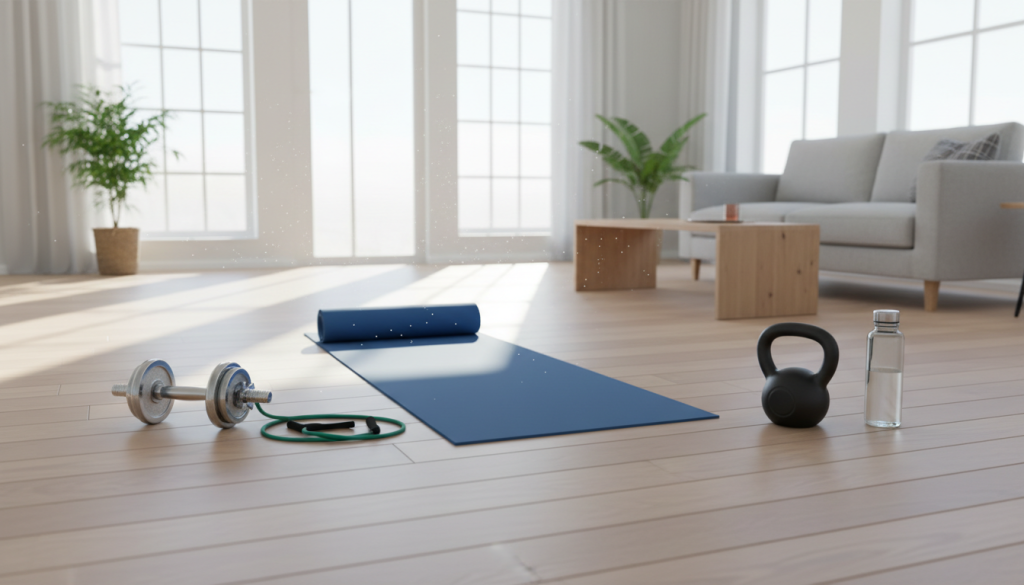
Bodyweight alone is enough to start. Useful additions include a resistance band, a pair of adjustable dumbbells or a kettlebell, and an exercise mat.
7 essential beginner exercises
1. Squat (legs and glutes)
Stand with feet shoulder-width apart. Push your hips back and bend your knees as if sitting into a chair, keeping your chest up and heels down. Push through your heels to stand. Make it easier by squatting to a real chair; make it harder by holding a dumbbell at your chest.
2. Glute bridge (glutes and hamstrings)
Lie on your back, knees bent and feet flat. Squeeze your glutes and lift your hips until your body forms a straight line from shoulders to knees. Pause, then lower slowly.
3. Push-up (chest, shoulders and arms)
Start with hands on a wall, kitchen counter or sturdy table (incline push-up). Keep your body straight, lower your chest toward your hands and press back up. Progress to lower surfaces, then the floor.
4. Row (upper back)
Loop a resistance band around a sturdy post or door anchor, or hold a dumbbell with one hand while the other rests on a bench. Pull your elbow back toward your hip, squeezing your shoulder blade, then return slowly.
5. Reverse lunge (legs and balance)
Step one foot back and lower until both knees bend to about 90 degrees. Push through the front heel to return. Hold a wall or chair for balance at first.
6. Overhead press (shoulders)
Holding light dumbbells or a band at shoulder height, press straight overhead without arching your lower back, then lower with control.
7. Plank (core)
Rest on your forearms and toes (or knees) with your body in a straight line. Brace your stomach and hold for 15–30 seconds, building up over time.
Your 4-week beginner plan
Train three days a week (for example, Monday, Wednesday and Friday). Warm up for 5 minutes with marching, arm circles and bodyweight squats.
| Week | Sets x reps | Plank | Focus |
|---|---|---|---|
| 1 | 2 x 10 | 2 x 15 sec | Learn the movements with perfect form |
| 2 | 2 x 12 | 2 x 20 sec | Control the lowering phase (3 seconds down) |
| 3 | 3 x 10 | 3 x 20 sec | Add light weights or a stronger band |
| 4 | 3 x 12 | 3 x 30 sec | Progress each exercise one step harder |
On other days, walking or cycling adds cardiovascular benefits. Regular exercise also helps lower cholesterol and improve sleep.
Nutrition for strength training
Muscles need protein to repair and grow. Most people who strength train benefit from around 1.2–1.6 g of protein per kg of body weight daily, spread across meals. See our guide on how much protein you need per day.
Common beginner mistakes
- Doing too much too soon and getting very sore or injured
- Sacrificing form to lift heavier
- Holding your breath (breathe out as you push or lift)
- Doing the same routine for months without progressing
- Skipping rest days
Frequently asked questions
How long until I see results from strength training?
Most beginners feel stronger within 2–4 weeks, largely due to the nervous system learning the movements. Visible muscle changes usually take 8–12 weeks of consistent training.
Is strength training safe for older adults?
Yes, and it is especially valuable for preventing falls and frailty. Start with light resistance and consider guidance from a physiotherapist or qualified trainer.
Will lifting weights make women bulky?
No. Building large muscles takes years of targeted training and eating. For most women, strength training creates a firmer, stronger body.
Medical disclaimer: This article is for general education only. If you have heart disease, high blood pressure, joint problems or a recent injury, check with your doctor before starting strength training. Stop if you feel chest pain, dizziness or sharp pain.
